The Ultimate Guide to Tights: Choosing the Right Pair for Every Occasion
Quick Overview
Choosing tights comes down to more than size and color. Denier, coverage, length, waistband construction, and fit all shape how a pair looks with your outfit and how it feels from the morning commute through an evening plan. This guide walks through each of those choices, from sheer versus opaque to blackout tights that stay in place, so you can find the right pair before you buy.
What Is Denier, and Why Does It Matter for Tights?
Denier describes the thickness (or fineness) of the yarn in the tight, so it gives you a quick sense of how light or substantial the knit may be. Lower-denier tights are usually more transparent, while higher-denier tights usually provide more coverage or opacity. The most utilized deniers are in the range of 10 to 100.
Treat denier as a guide, not a guarantee. Color, fabric blend, stretch, and fit can all change how sheer or opaque a pair looks once you put it on. A black pair at the same denier can appear more covered than a lighter shade.
- 10–20 denier: sheer and light. Choose this range when you want a polished finish with just a hint of color. This range provides minimal coverage. It works well with office dresses, special-occasion outfits, and closed-toe heels. Our Women’s Sheer Footed Tights are a footed option with a soft, flat waistband for shoppers who want a lighter layer. Looking for the ultimate in transparency? The Ultra Sheer style at a light 15 denier will let your natural skin tone show with an overlay of just a hint of color.
- 30–40 denier: everyday coverage. This is the middle ground when you want more coverage than a sheer without moving into a heavy tight. Our 40 Denier Footed Tights have been our top-selling cold-weather staple for years because they are incredibly affordable and perfect for everyday wear. We offer these with a built-in Control Top, providing a smooth, supportive silhouette under fall dresses and wool skirts without ever feeling restrictive. The shorter Capri and Ankle lengths can work well with cropped trousers, flats, and transitional-weather outfits.
- 70 denier and above: Full coverage often used for cold weather. Our Blackout Footed Tights are 80 denier and made for a true blackout finish. This Blackout style provides complete coverage and the smoothest look available. If warmth is the priority, our Women’s Black Fleece Footed Tights add a soft fleece lining beneath an opaque black exterior.
Denier also affects how the tights work with the rest of your outfit. A lighter knit may suit smooth fabrics and dressier shoes, while a heavier knit often feels more at home with boots, sweater dresses, and thicker skirts. You do not need to follow a strict rule, but the balance is usually easier to see once you put the whole outfit together.

When you are shopping online, compare the denier with the product description and the use case. A 40-denier ankle tight and an 80-denier blackout tight are both more covered than a sheer, but they answer different needs. One is built around a shorter, transitional-weather length; the other gives full footed coverage for cooler days.
A higher-denier pair can be more useful when you expect boots, cold sidewalks, or a full day on your feet. Higher denier also generally means a denser knit that holds up better to wear, which the durability section below covers.
Sheer vs Opaque Tights: A Quick Comparison
Sheer tights give the leg a lighter, more polished finish, while opaque tights create more coverage and warmth. Choose sheers for formal office outfits, events, or days when you want your natural skin tone to show through choose opaques for medium coverage and cooler Fall weather. For a fuller side-by-side explanation, see our guide to sheer tights vs. opaque tights.
40 Denier Opaque vs 80 Denier Blackout Tights
When deep winter arrives and the temperatures drop, you need maximum warmth and absolute coverage.
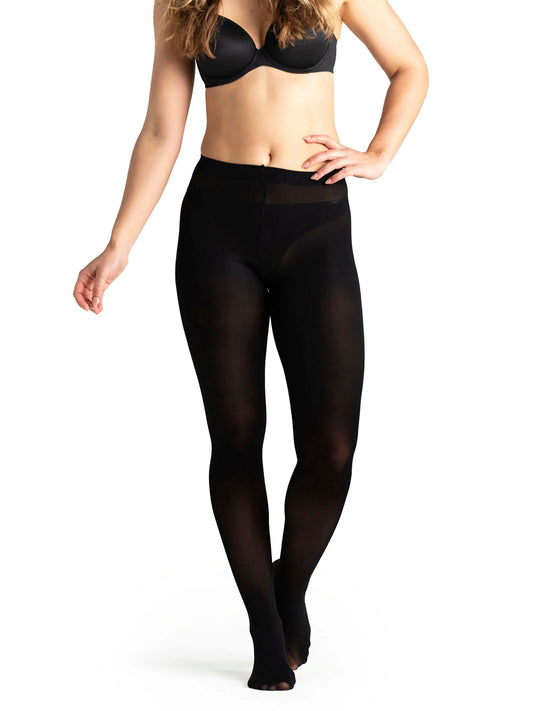
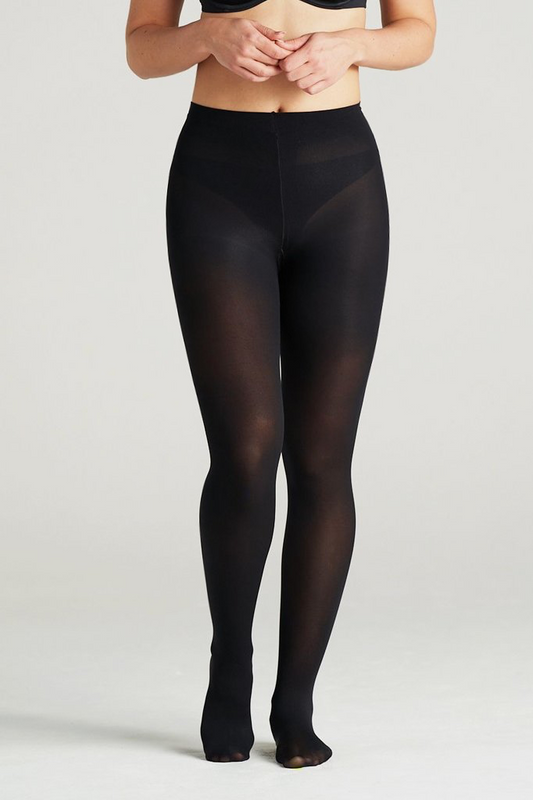
Do not confuse Opaque with Blackout. While a 40-denier tight is opaque, an 80-denier tight is a true blackout style. Our 80 Denier Blackout Tights yield 100% opacity with absolutely zero skin show-through. These are the heavy-duty winter upgrade, designed to insulate your legs against freezing temperatures. They create a stark, sleek, uniform color block that pairs flawlessly with heavy winter coats, oversized sweaters, and tall boots.
What Tights to Wear to Work With a Dress or Skirt
Work tights need to do a few jobs at once. They should look neat with your dress or skirt, feel comfortable through a full day, and make sense with the shoes you wear most. Start with the dress code, the weather, and the level of coverage you prefer.

For tailored dresses, pencil skirts, and formal offices, 10–20 denier sheers often give the most subtle result. They finish the leg without adding much visual weight. Black works with darker shoes and dresses, while a neutral shade creates softer contrast with a lighter outfit.
For a regular office day, 20–40 denier gives more coverage without feeling like a winter layer. Black pairs easily with darker, patterned, and jewel-toned outfits. Navy can work well with blue-based looks, and a neutral shade can be useful when you want less contrast.
A black sheath dress and closed-toe pumps usually call for a sheer or lightly opaque finish, depending on the season. Let the dress and shoes lead, then choose the coverage that keeps the outfit balanced. If the dress is light or the office is formal, a sheer often does the quieter job.
A sweater dress and boots usually benefit from more coverage. Opaque black tights create a clean line from the hem to the shoe, and a higher denier can make the outfit feel more practical when temperatures drop. If you are outside often, a fleece-lined style may be worth keeping for the coldest days.
For an office-to-dinner outfit, focus on a pair that stays comfortable after several hours of wear. A control-top style can be useful beneath a fitted dress, while a sheer pair keeps a lighter outfit from feeling too heavy. The best option is the one you will not be thinking about by the end of the day.
Pay attention to the waist as well as the leg coverage when you wear a fitted dress or skirt. A pair that fits well is less likely to need adjusting, and a control top can create a smoother base beneath closer-fitting clothing. Our Women’s Classic Control Top Footed Tights have a control-top panel, opaque black coverage, and a soft, non-binding waistband.
Shoe choice can narrow the options quickly. Sheer-footed tights work with pumps, loafers, closed-toe flats, and many ankle boots. Opaque footed tights suit boots well because the coverage continues through the foot.
If you are wearing cropped trousers or shoes that leave the ankle visible, an ankle-length style gives the outfit a cleaner break than a full footed pair. Our Classic Ankle Tights are 40 denier and end at the ankle. For a mid-calf option with a lighter feel, look at our Classic Capri Tights.
Before leaving the house, check three things: the waistband should feel comfortable, the shade should work with the shoes and hemline, and the coverage should suit the season. A small rotation of sheers, opaque black tights, and a warm pair can cover most workweeks.
You can compare the current range in our Women’s Tights collection. Product pages provide the details that matter when you are choosing a length, fabric, or level of coverage.
Black Tights That Don't Roll Down or Sag: What to Look For
A pair of black tights earns a place in your drawer when it stays comfortable. If you are pulling at the waistband all day, start with the construction, rise, fabric stretch, and size. Those details usually matter more than the price on the tag.
Features That Keep Tights in Place All Day
Start with the waistband. Look for one that lies flat against your body instead of feeling narrow, rigid, or overly tight. A soft, supportive waistband can spread pressure more evenly and reduce the digging that often leads to rolling.
Next, consider the rise and the level of support you want. Mid-rise and high-rise tights can both work, but the best choice is the one that sits where you naturally wear your waistbands. A control-top panel adds structure through the upper part of the tights and can smooth the waist, tummy, and hips under fitted clothing.
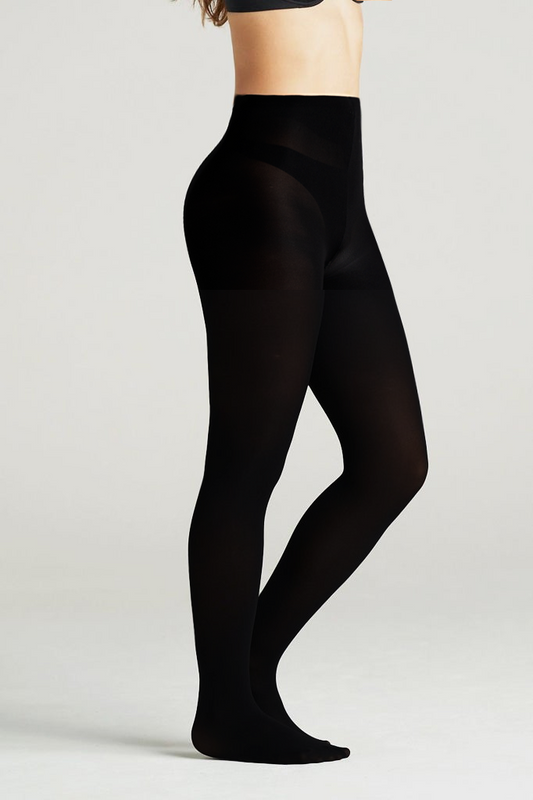
Our Women’s Classic Control Top Footed Tights are a useful example. They combine a high-waisted, non-binding waistband with a control-top panel and an 83 percent nylon, 17 percent spandex fabric blend. That construction is suited to shoppers who want opaque coverage and shaping support in the same pair.
Fabric stretch matters, too. A blend with elastane or spandex should move with you and recover after sitting, standing, and walking. Too much tension can make any pair feel as though it is pulling toward a smaller shape.
Check the foot and leg as well. You need enough room through the toes and enough length through the leg for the knit to stay smooth. If the fabric is pulling at the calves or bunching at the knees, the waistband will have a harder time staying where it belongs.
The rest of the outfit has an effect, too. A smooth skirt lining or slip lets layers move together more easily. Tight shapewear, rough textures, or a skirt that catches at the waistband can create friction and make you adjust more often.
If rolling starts at the top edge, the waistband may be too tight, too narrow, or sitting at the wrong point on your torso. If the tights slide from the hips instead, you may need a different size or more structure through the upper portion. These are fit clues, not failures on your part.
Getting the Right Fit
Sizing correctly is usually the first fix for rolling or sagging. Tights that are too small can overstretch at the waistband and fold as you move. Tights that are too large can collect at the ankles, knees, or waist and gradually slide down.
Use your height and weight together when you check a hosiery size chart. That gives a clearer picture of how the tights will distribute across the legs and torso than a clothing size alone. We provide separate guidance for ankle, fleece, blackout, and control-top styles in our Sizing Chart.
Do not automatically size up to stop rolling. Extra room may solve one pressure point but create looseness elsewhere. Follow the chart for the specific style, then check the product description if you are deciding between two options.
Put tights on in small sections instead of pulling from the waistband. Gather each leg down to the toe, place your foot, and work the knit up gradually. Smooth from the ankle upward so fabric does not pool at the knees or pull too tightly at the waist.

A quick fit check takes less than a minute. The toes should not feel compressed, the fabric should sit smoothly across the knees, and the waistband should stay flat when you sit down. If one of those things is off, try a different size, rise, or style before deciding that black tights just do not work for you.
Support should feel comfortable, not restrictive. If a control-top pair leaves you distracted by pressure at the waist, the size or style may not be a match for your body or outfit. If you only want opaque coverage, a standard black pair may give you the finish you want without added shaping.
Are Affordable Tights Worth It? Durability Explained
Affordable tights can make sense when you match the pair to the job. Price does not tell you everything about how a pair will wear. A very sheer knit needs more care than an opaque style, whatever it costs.
Runs usually begin with a pull in the yarn. A chipped nail, a rough shoe edge, jewelry, a zipper, or friction against a textured fabric can start a snag. Once a delicate knit is damaged, the tension can travel through the fabric and create a visible run.
Denier matters here because a more substantial knit usually has more yarn density. That can make it a better choice for boots, frequent wear, or cold weather. It does not make the tights snag-proof, so it is still worth handling every pair carefully.
Think about cost in terms of the situations you need to cover. A very sheer pair may earn its place for a wedding, presentation, or light office outfit. Opaque or fleece-lined styles make more sense for a regular boot-and-dress rotation during cold-weather commutes and outdoor errands.
It also helps to keep your tights separated by use. Save delicate sheers for outfits where the lighter finish matters. Reach for a more covered pair when you know the day includes stairs, travel, rougher fabrics, or a lot of time in boots.
When you compare affordable tights, look for details that match how you will wear them. A reinforced toe can help if you spend a lot of time in closed-toe shoes. A comfortable waistband matters if you wear tights through a long workday, and an opaque finish can be easier to repeat when you want more coverage.
For full black coverage in cool weather, our Classic Blackout Footed Tights are 80 denier with a high-waisted cut and soft waistband. For a lighter look, our Women’s Sheer Footed Tights offer an ultra-sheer finish and a 94 percent polyester, 6 percent spandex blend. The two styles solve different problems, so choosing between them comes down to coverage and occasion, not a single idea of durability.
How you put on and wash tights affects their lifespan. Take off rings or bracelets that could catch the fabric, smooth rough nails, and gather the knit down each leg before putting it on. Follow the care label, use cold water when the instructions call for it, and keep tights out of high heat.
Give each pair a quick look before wearing it again. Check the toes, the inside of the thighs, and the waistband for snags or stretched areas. Catching a small issue before you leave home gives you time to switch pairs instead of trying to make a damaged pair work through a full day.
Match the denier to the season, choose the fit carefully, and treat the knit gently. Those habits give affordable tights a better chance of becoming reliable pieces in your regular rotation.
Tights Styles at a Glance
Length, lining, and level of coverage can change how a pair works with an outfit. Here are six current styles to compare.
- Classic Control Top Footed Tights: 40-denier, opaque black footed tights with built-in smoothing support for fitted dresses, skirts, and everyday wear.
- Classic Ankle Tights: 40-denier, ankle-length coverage for flats, heels, ankle boots, cropped pants, and transitional weather.
- Classic Capri Tights: 40-denier, mid-calf coverage for warmer days, dresses, tunics, skirts, and layered looks.
- Women’s Black Fleece Footed Tights: fleece-lined, opaque footed tights for cold-weather layering with dresses, skirts, boots, or pants.
- Classic Blackout Footed Tights: 80-denier, full black coverage for cool days, boots, workwear, and dressier outfits.
- Women’s Sheer Footed Tights: ultra-sheer, footed coverage with a soft, flat waistband for office days, evening plans, and dressier outfits.
Start with the style that solves your most common problem. If you usually need coverage with cropped trousers, look at ankle tights.
If winter warmth drives your choice, compare fleece and blackout options. This keeps the choice practical and helps you build a smaller rotation that you will actually use.
If you wear tights only for occasional workdays or events, two styles may be enough: a sheer pair for lighter looks and an opaque black pair for more coverage. That gives you a clear choice without filling a drawer with options that overlap.
If you wear tights several times a week, add a pair that solves a specific problem. That could be a control-top style for fitted dresses, ankle tights for cropped pants, or fleece-lined tights for cold weather. Each pair should have a job you recognize before you buy it.
Keep a Backup Pair of Black Tights on Hand
A spare pair of black tights can save a busy morning. You do not need a special multipack to make that habit useful. Keep a second pair of the style you wear most often, and a snag or sudden change in weather will not force an outfit change.
Choose the backup around your routine. If you wear dresses or skirts to work, a second pair of Classic Control Top Footed Tights gives you opaque coverage with smoothing support. If you wear boots or need more coverage in cold weather, a backup pair of Classic Blackout Footed Tights may make more sense.
Keep the spare in a desk drawer, work tote, travel pouch, or the back of a dresser drawer. Leave the packaging on until you need it, then replace it when you open it. That simple routine turns a last-minute snag into a quick change.
If black is not the color you wear most, apply the same idea to the neutral or sheer style you reach for most often. Keep the backup focused on the situation you encounter most often, whether that is an office day, an event, or a cold-weather commute.
With this tights guide as a starting point, compare the styles in our Women’s Tights collection to find the pair that fits your routine.